AND ITS PRONUNCIATION
The Hebrew Text we have today differs considerably from that which was originally given. Since the days of the Masorites, the preservers of the traditional text, there seem to have been no great number of vital changes, for their system of counting the letters and cataloguing other facts has tended to stabilize their text. This is especially true since the invention of printing. But the very fact that it was deemed necessary to protect the text by ‘putting a fence about it’ suggests that corruption had been at work for a thousand years before. No (complete) Hebrew manuscript (except Isaiah) goes back more than a thousand years. Before that, old copies were usually destroyed when new ones took their place. The Greek and other translations, some of which go back a thousand years earlier, reflect a text which often differs from the one now used in making our Bibles.
THE ANCIENT FORM OF THE LETTERS
We can go back to the days of Hezekiah for the forms of the Hebrew letters. We have the Lachish letters and the Siloam inscriptions which once was in the wall of the tunnel running under Ophel, about twenty feet from the pool of Siloam, to show us just how they wrote Hebrew before this time and until the deportation. With the return from the deportation the Jews brought with them the Aramaic dialect and the square characters which are now generally known as ‘Hebrew’. These letters were probably used in writing the Syriac or Aramaic portions of the Scriptures, but not for the rest. The original forms were abandoned because the people no longer were acquainted with them.
HEBREW PRONUNCIATION
The ancient
Hebrew letters are no longer in use. So-called ‘Hebrew’ Bibles really employ an
entirely different alphabet, which is variously termed Chaldee or Syriac or
Aramaic. In the course of time the pronunciation of the vowels changed, so a
new and different pronunciation was added by means of so-called ‘points’,
little dots and dashes beneath, in, or over the letters. The original vowels, however,
were retained, except that ‘u’ and ‘i’ were often omitted in spelling, because
their sounds were already indicated by the points. Today, however, the vowel
points themselves are variously pronounced by different classes of Jewish
scholars, and the whole matter is in confusion. We avoid this difficulty in the
simplest way. We use a Latin (or English) character for each ancient Hebrew
letter, including the vowels, and ignore the uninspired ‘points’, which add
nothing to the sense, but only duplicate the vowels, as a rule.
The following examples will make
this clear. The first is all vowels, the second mixed, and the third all
consonants. The word ‘oue’, ‘depraved’, was doubtless pronounced just as it is
spelled, in ancient Israel. Now that two little characters, like capital T’s,
have been added under the o and u, the usual way of transliterating it into
English, would entirely ignore the real vowels in the word. The word ‘adm’,
human, also has two small T’s beneath it. In English we spell Adam with two
a’s, but the second ‘a’ is not pronounced. We say ‘adum’. This slight ‘u’
sound is often needed in Hebrew to pronounce a word and must be supplied. We
call it the ‘involuntary vowel’, because it comes of itself when we try to
pronounce two consonants one after another. Our next example calls for two of
these. The word ‘nphsh’, ‘soul’, has points that would make it ‘nephesh’, which
is almost the same as nuphush.
The original pronunciation of Hebrew, the
manner in which David and Abraham and Adam spoke
the tongue of inspiration, is a problem which we thought far beyond our range.
As we did not deem it essential we gave it small attention at first. Later,
when it seemed wise to put the inspired text before our readers in well-known
Latin in place of Chaldee characters, we found it necessary to determine, to
some degree of accuracy, what are the nearest equivalents, so that there would
be at least an approximation to the facts. The efforts made in this direction
have been far more convincing than we anticipated, hence we will give a short
account of the means used and the results attained.
HEBREW A NATURE LANGUAGE
Sounds in
nature do not change. The peoples of the earth are continually varying their
mode of talking, but the voices of the animals and the sounds made by inanimate
objects continue as they were in the beginning. A stranger in a foreign land,
who is homesick because the voices all about are barbarous, can cure it by
going among the animals, for these speak the same language as those at home.
The dogs bark, the hens cackle, the roosters crow, the donkeys bray in the same
dialect wherever we find them. In its close connection with nature we may find
a key to the pronunciation of the Hebrew tongue, as it was spoken in the days
of old, before the Jews learned many other languages and adapted their own to
these outlandish tongues.
The first hint of this that I came across was
the word ‘bqbq’. This is the name they gave to a bottle. If we empty a fluid
out of a narrow-necked container which has no means of allowing air to enter it
to displace the fluid withdrawn, the flow will stop occasionally so that a
bubble of air may slip by. In doing this it makes a characteristic sound,
‘buq-buq’, which gives the vessel its name in Hebrew. Now an American bottle,
or an English one, or even a Chinese flask all make the same sound if they are
shaped the same, and this has always been the case. We may, then, conclude that
all bottles or narrow-necked containers can speak one word of Hebrew correctly,
and it will be our duty and pleasure to learn it from them.
But we can learn much more than that. We know
what letters were used to represent this sound in Hebrew, ‘b’, ‘u’ and ‘q’, so
we have a clue to their true and ancient pronunciation, especially if this is
confirmed by other similar cases. Just lately a worker on the
Hebrew called my attention to the word heart, which we have made ‘lbub’. (It is usually
shortened to ‘lb’). Now listen to a heart beat. Is not this as close as we can
get to the sound made by it ? This is hardly clear enough to base much upon,
but it seems to confirm what we have learned before. We now know the sounds of
four letters in Hebrew.
Now let us inquire of the birds. The partridge
seems to know one word of Hebrew. Its call is
‘qra’, and this is also its name (1 Sam. 26 : 20). And this is the sound it
still makes after thousands of years. So once again we have a ‘q’ sound,
besides ‘r’ and ‘a’.
Though we cannot feel nearly so safe in basing
anything upon them, it does seem that some words have come down to us altered
but very little by the course of time. Such a one is ‘ebuni’, which is
practically the same as our ‘ebony’. This adds to our list ‘e’ and n and ‘i’,
though we will find that ‘i’ is ‘ee’ rather than ‘ih’. The word
‘qnmun’ means ‘cinnamon’, so is nearly Hebrew, and adds the letter ‘m’ to our
list. Some English words from the Hebrew are helpful, as ‘iubl’, ‘jubilee’.
‘Amn’ (‘Amen’) corroborate what has been said.
COMPARISON WITH THE GREEK
Perhaps the
best human means of checking the ancient pronunciation is to be found in the
transcription of Hebrew names in the Septuagint. Being human, we cannot place
much reliance on details, but a general view should give us an idea how Hebrew
was spoken in the third century before Christ, when the Septuagint was
translated. Where this agrees with our findings in other fields it should be
final. This we find to be true for most of the letters. A vowel or two and the
labials are the only exceptions. We find that the comparison breaks down,
however, where the Greek has no equivalent, or where the vowels have already
begun to vary in Hebrew.
I am indebted to friends for a list of over
five hundred proper names which gives the
spelling of the Greek and the Hebrew, and a column for every Hebrew letter
showing which Greek
letter was used in transcribing it.
The easiest way to examine this table will be
to check off those letters first which are settled
beyond a doubt by the figures. Thus Hebrew ‘b’ is rendered by the Greek ‘b’ 112 times with
only six departures, and ‘g’ is ‘g’ 27 times with only two exceptions. The
following letters are likewise determined once for all by this table : ‘d’ 80
(2 off), ‘z’ 28(1), ‘th’ 60(9),
‘i’ 194(14), ‘1’ 128(3), ‘m’ 149(4), ‘n’ 123(4), ‘r’ 155(2), ‘ph’ 47(only 3
‘p’). About half of the letters need no further examination because the
evidence against them is not of sufficient weight to warrant it.
Some of these, however, are of special interest
because the Greek distinguishes closely related
sounds. Thus ‘th’ is used only once for ‘t’, while ‘t’ is so transcribed 13
times, though 9 times it is also made ‘th’. Scholars today, while they would
probably acknowledge that these letters were quite distinct in primitive Hebrew
(in which alone we are interested) would give ‘th’ both sounds, that is, almost
identical with ‘t’ when it has a dot within it. This, however, seems to be the
result of contact with other languages, as this table shows, and not the pure
Hebrew we are after.
Modern Hebrew has both ‘p’ and ‘ph’ (or ‘f’).
The difference is indicated by a dot in the letter,
which hardens it to ‘p’. Independent investigation led me to conclude that
ancient Hebrew had no ‘p’. It was always soft, ‘ph’ (or ‘f’). But this was
challenged, so a friend went through the proper names in the Septuagint at my
request, and found that ‘p’ was never used in pure transcriptions. While in
Palestine I was struck with the name of the Arab newspaper ‘Falastin’ (in place
of ‘Palastin’), and I found that the Arabs there could not pronounce the letter
‘p’. Evidently it is not used in modern Arabic. Further inquiries confirmed
this. The table now made seems to settle the matter finally. ‘Ph’ is used 47
times and ‘p’ only 3 times. In these cases the Greeks did not transcribe, but
spelled as was their custom, just as we do so often in English. We will not
transcribe ‘Phr’ in our translation, but make it ‘Persia’, for so we are
accustomed to call the country in our own language.
The Hebrew letters ‘s’ and ‘sh’ have a story
all their own. It seems that these letters are easily
confused. In parts of Europe the colloquial dialect uses ‘sh’ for ‘s’ always,
for the people
cannot pronounce ‘s’. The opposite seems to have been the case in Ephraim in
early times (Jd. 12 : 6). When Jephthah with his Gileadites defeated them and
caught them at the fords of Jordan, he tested them to see if they were
Ephraimites by asking them to say ‘Shibboleth’. But it seems that this tribe
could not pronounce the ‘sh’ sounds, so they said ‘Sibboleth’, and paid for it
with their lives.
But Greek has no ‘sh’. How, then, could they
translate this passage ? Very simply! They left
out a part and only said that the Ephraimites could not pronounce the word. The
two versions of the LXX I have consulted carefully avoid the word ‘shibboleth’
because the Greeks also could not pronounce it. Each one translates it by a
different Greek word. Does not this show conclusively that there was no ‘sh’
sound in Greek ? Hence it is clear that we cannot get this sound through the
LXX. So also with ‘tz’. Greek could not distinguish between these three
letters. Therefore ‘s’ does duty for them all. We are more fortunate, we have
no letters, indeed, but we have combinations, and can pronounce the sounds of
‘sh’ and ‘tz’, so can keep them distinct from ‘s’.
THE HEBREW VOWELS
Vowels are the most unstable sounds in any language. Even in the living languages, there is more difference in these few letters than in all the rest combined. The enunciation of an American differs from the literary English chiefly in this regard. Hebrew has changed greatly in the course of time. The alteration has been so great, indeed, that the old vowels are now silenced, and a new set has replaced them. Even when the Septuagint was made this process was well under way.
In the names, ‘a’ was rendered by ‘a’ (78), ‘e’ (20), ‘ee’ (22), ‘o’
(9), and ‘oo’ (3).
The letter ‘e’ was made ‘a’ (12), ‘e’ (l), ‘ee’ (2), o (7).
‘U’ was transliterated ‘a’ (5), ‘e’ (2), ‘i’ (1), ‘o’ (5), ‘u’ (20),
‘oo’ (63).
‘I’ was written ‘a’ (2), ‘e’ (6), ‘ee’ (2), ‘i’ (194), ‘o’ (1), ‘u’
(l), ‘oo’ (2).
‘O’ appears as ‘a’ (36), ‘e’ (16), ‘ee’ (7), ‘o’ (13), ‘oo’ (2).
So great is this confusion that it has hardly any weight in deciding
the proper pronunciation of these letters. But, in contrast with present
practise, ‘u’ is a vowel (not ‘v’), and so is ‘e’ (not ‘h’), and ‘o’
(not ‘ng’).
If the transliteration of the proper names
sheds little light, it at least shows that they are vowels, and that
is most important at the present time, when ‘a’ and ‘o’ are denied even
a letter, being given only apostrophies which have no sound at all.
Hebrew had (and pure Hebrew has) vowels, just like other languages.
These must be restored.
The manuscript of Isaiah, found at Qumram, which may go back to the century before the birth of Christ, has the vowels as we have transliterated them in the Hebrew text.
In each alphabet the most open of all the vowel sounds seems to come first. It is ‘a’ (‘ah’), That this was so in Hebrew seems to be settled by the cry of the partridge. This is the most-used sound in the proper names, so there seems to be little doubt that the Hebrew ‘a’ was originally ‘a[h]’, as in ‘father’.
The vowel ‘u’ (now usually given as ‘v’ or ‘w’) is found in the full spelling of ‘buqbuq’, hence it has the sound of long ‘u’. This is confirmed by the fact that the LXX transcription makes it either ‘u’ or ‘o’.
That ‘i’ (pronounced as long ‘ee’) is ‘i’ seems settled by the Greek transcription. There is no case for the present method of making it ‘ahee’.
That the letter ‘o’ (generally represented by a reversed apostrophe (‘) is a real vowel is clear, for it is always represented by one in the transcription. Coming between ‘m,n’ and ‘p’ in the alphabet, it seems the only one for the missing ‘o’ sound.
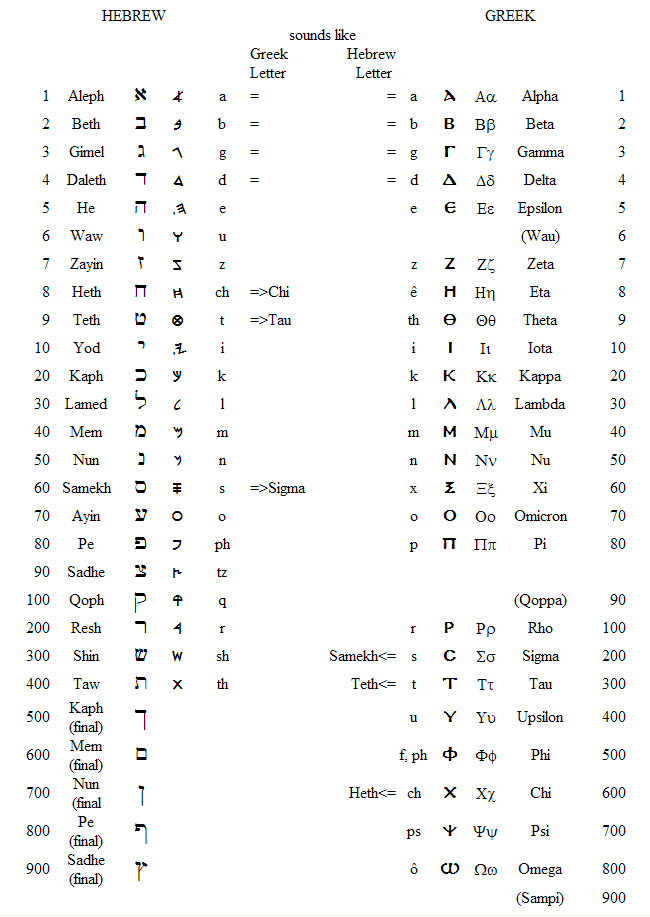
Our system of transliteration is as simple as it can be. It may be used with any Hebrew text or lexicon, with the equivalents shown in the table below.
Excerpt from : ‘Introduction to the Concordant Version of the Old Testament’
Concordant Publishing Concern, 1957
THE HEBREW VOWELS
At present Hebrew Bibles are printed with
innumerable little dots and dashes below, above and in the letters. These
indicate the pronunciation and the tone, and fix the grammar. These ‘points’
were unknown before the sixth century, so are not inspired. They were gradually
added by the so-called Massorites, in order to preserve the traditional oral
rendering of the text. Theirs was no attempt to give the ancient or original
text or pronunciation—only that current between the sixth and the tenth
centuries. Therefore it is of little value for us, who wish God's Word, and not
man's wisdom.
The addition of the so-called vowel points
tended to make certain letters practically useless. When translated into
English, the first letter of the alphabet aleph is now represented by a spiritus
lenis (‘), which is not pronounced at all. The sixteenth letter oin
is represented by a similar sign, but curved in the opposite direction (’),
though it is supposed to have a varying, uncertain sound. The tenth letter yod,
and the sixth wav are practically useless. There can be no question that
these letters had their use before the vowel signs were added. The ancient
language would not lack the necessary vowels and, at the same time, insert a
lot of silent letters, for it is a tongue of utmost brevity. I saw the Lord's
Prayer in about twenty different languages on the walls of a church in the
mount of Olives, and the Arabic and Hebrew had far fewer words and letters than
the other languages.
If we discard all of the signs, leaving the text
unpointed, we are in a dilemma until we see that these letters are really
vowels, and were such until the signs displaced them. If we range the Hebrew,
the Greek, the Latin, the German and the English alphabets alongside each
other, we are immediately impressed by their similarity, not only in regard to
letters, but in the order in which these occur. For instance, Aleph, Alpha,
and the Latin, German and English A begin the alphabets, and there is
very little doubt that they all have the open ah sound. Yod will
be seen to correspond with i, but sounded as long ee, as in all
continental tongues. Wav is undoubtedly u. Oin comes where
the later alphabets have o.
Thus we have the vowels a, i, o,
and u. We lack only the short e sound, the eh. Looking
again at our alphabets, we find the so-called Hebrew h in its place. Can
it be possible that this is the lost eh? Many tests have convinced me
that it is. In many words it is hardly possible to distinguish between eh
and h. For our present purpose we will assume this to be so. Thus we
have five vowels, a, e, i, o, u, pronounced ah, eh, ee, oh, oo.
Our English long a ay is really a diphthong, ehee,
not a single vowel. These will be found quite ample, with one exception.
In
many Hebrew words consonants come together without any vowel between them. They
cannot be pronounced without some sort of link. Much practice and
experimentation has convinced me that this vowel is involuntary. That
is, if we try to vocalize two succeeding consonants, we instinctively insert a
short vowel sound. It is not necessary to have a letter for this because it is
inherent in the human vocal organs. This sound is uh. I have named this
the "involuntary vowel," which comes without effort or direction,
when we seek to bridge the gap between two consonants.
Thus we have all the vowels in Hebrew without
the vowel signs. Further investigation has suggested the following
simple equivalents for the Hebrew letters, which we will use in the future in
our writings, and in the Hebrew Indexes and Lexicon. By this simple means any
Hebrew word can be immediately pronounced. Only remember the involuntary vowel
between consonants, and that i is long e.
Excerpt from : Unsearchabe Riches Magazine March
1934
TABEL The alphabets